
The best dog water bottle for hiking depends on your dog’s size, hike length, refill options, and whether you’re day hiking or backpacking. This comparison covers integrated trough bottles, an insulated option, and a bowl-and-filter setup.
| Bottle | Price | Weight | Capacity | Best For |
|---|---|---|---|---|
| Springer Flip | ~$25-35 | 4.9 oz | 20 oz | Best Overall |
| PupFlask Portable | ~$27 | Check selected size | 27/40 oz | Best for Large Dogs |
| MalsiPree Portable | ~$22 | 0.33 lbs | 19 oz | Best Budget |
| Springer Insulated | ~$35-40 | 1.1 lbs | 24 oz | Best for Hot Weather |
| Ruffwear Bowl + Sawyer Squeeze | ~$55-65 | 3.6 oz | Unlimited | Best for Backpackers |
For short walks and park trips, the MalsiPree’s one-handed squeeze means you never juggle a leash. Day hikers with small-to-medium dogs grab the Springer Flip — pair it with a trail harness to keep both hands free for poles. Large dog owners go PupFlask. Budget pick is the MalsiPree. Summer heat calls for the Springer Insulated, and backpackers skip bottles entirely for a Ruffwear bowl with a Sawyer Squeeze filter. On rocky or technical terrain, dog hiking boots protect paws alongside any water setup.
How Much Water Does Your Dog Need on Trail?
Plan water around the individual dog and the route, not a formula. The amount a dog needs can change with health, conditioning, weather, terrain, pace, and the availability of safe refill points. Before leaving, identify where you will carry water and where you can safely refill; VCA’s hiking guidance recommends bringing enough water and a bowl, and discussing any health limits with your veterinarian.
Offer water regularly and watch the dog, not just the bottle. Plan pauses so your dog has repeated chances to drink, especially when conditions are demanding. If your dog shows concerning heat-related signs such as heavy panting, excessive drooling, weakness, disorientation, vomiting, loss of coordination, or collapse, stop the hike, move them out of the heat, begin gradual cooling, and seek veterinary care promptly. Merck’s heat-safety guidance and the AVMA pet first-aid guide both recommend urgent veterinary care for suspected heatstroke.
A bottle is only one part of the plan. Choose capacity based on the route’s known water access and carry options. On routes without reliable safe water, carry the water your dog will need or choose a shorter, cooler outing. A bowl-and-filter system can work where a suitable water source is confirmed, but it is not a substitute for planning.
1. Springer Flip Dog Water Bottle
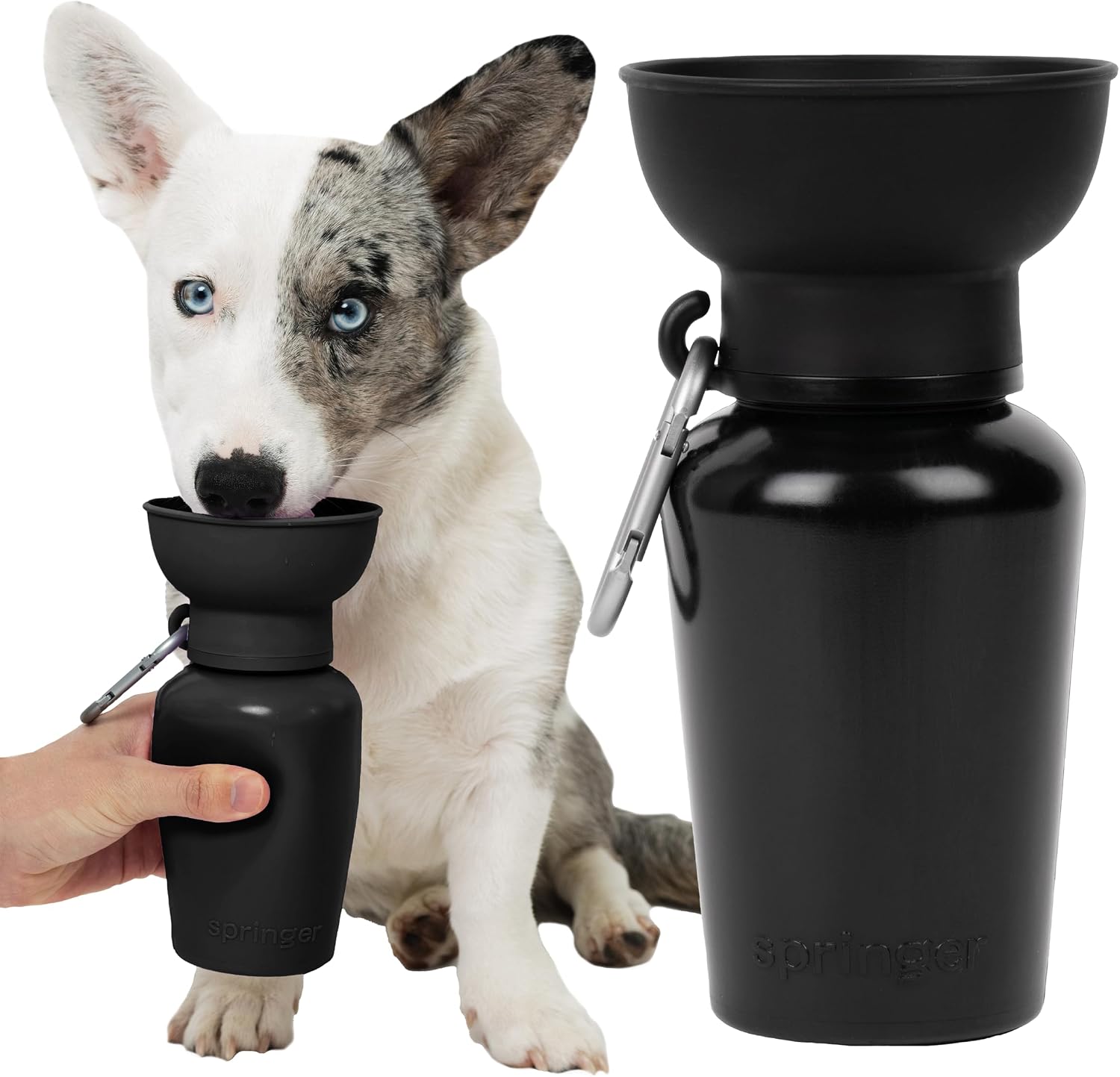
Best Overall. The Springer Flip weighs 4.9 oz empty, holds 20 oz, and costs $25-35. That weight makes it the lightest integrated dog water bottle on the market. For day hikers who count ounces, nothing else comes close.
Squeeze-to-fill design eliminates fumbling. You flip the attached trough open, squeeze the bottle, and water fills the bowl. Your dog drinks, you release pressure, and unused water drains back in. Treeline Review tested the Springer Flip on 8 dogs ranging from 20 to 95 lbs over 2+ months and rated it their top pick.
At 4.9 oz, it disappears in your pack. Clip it to a hip belt, drop it in a side pocket, or hand-carry it. The slim profile fits standard water bottle pockets on most daypacks. Filled, you’re looking at about 1.4 lbs total.
The valve does wet your hand. Every squeeze pushes a small amount of water past the seal onto your fingers. It’s not a dealbreaker, but it’s worth knowing if you’re fussy about grip on trekking poles.
The bigger limitation is capacity. At 20 oz, this bottle suits short outings and requires a separate plan for longer routes, larger dogs, or limited water access.
Best for: Day hikers, small-to-medium dogs, 2-3 hour hikes in mild weather. Skip if: You have a large dog or plan 4+ hour hikes in heat. The 20 oz capacity can’t keep up.
2. PupFlask Portable Dog Water Bottle
Best for Large Dogs. The PupFlask comes in 27 or 40 oz stainless steel versions. If you hike with a 50+ lb dog, this is the first bottle to look at. The 40 oz version gives you twice the capacity of most competitors.
Widest bowl of any integrated bottle. Large dogs struggle with narrow trough openings. They lap half the water onto the ground instead of into their mouth. The PupFlask’s bowl is wide enough for a Lab or German Shepherd to drink comfortably without spilling a third of each serving.
Stainless steel solves two problems at once. Plastic bottles left in a sun-baked vehicle release compounds into the water that some dogs taste and refuse. Stainless steel doesn’t hold flavors between fills, so dogs that reject funky-tasting water from plastic often drink without hesitation from steel.
Weight math matters for hikers. Choose the 27 or 40 oz size based on how much water you need to carry between refill points. The larger bottle carries more water, so check the selected size before deciding whether it fits your pack or day-hike setup.
Best for: Dogs 50+ lbs, moderate day hikes of 3-5 hours, owners who want stainless steel. Skip if: You’re an ultralight hiker or have a small dog. The weight and bowl size are overkill under 40 lbs.
3. MalsiPree Portable Dog Water Bottle
Best Budget. The MalsiPree weighs just 0.33 lbs, holds 19 oz, and costs around $22. With 30,000+ Amazon reviews, it’s the most popular dog water bottle on the market. The price-to-function ratio is hard to beat for casual hikers.
True one-handed operation sets this apart. Press the lock button, squeeze the bottle, water fills the trough. On trail, your other hand is holding a leash or a trekking pole, and any bottle requiring two hands means stopping completely and breaking your rhythm. The MalsiPree doesn’t ask for that.
The bowl opening limits dog size. Dogs over 40 lbs will struggle to drink efficiently from the narrow trough. Smaller breeds and medium dogs do fine. The silicone seal where the trough meets the bottle can develop mold if you don’t clean it weekly. Disassemble completely, soak in white vinegar for 10 minutes, and air dry open.
Best for: Casual hikers, small-to-medium dogs under 40 lbs, anyone on a budget. Skip if: You have a large dog or plan multi-day trips. The capacity and bowl size won’t cut it.
4. Springer Insulated Dog Water Bottle
Best for Hot Weather. The Springer Insulated holds 24 oz in a double-walled stainless steel body, weighs 1.1 lbs empty, and costs $35-40. It keeps water cold for 12 hours. That single feature solves a problem most hikers don’t think about until it’s too late.
Water in a dark pack hits 90F+ within an hour on summer hikes. Dogs refuse warm water, and a dog that won’t drink starts a dehydration cycle that accelerates with every mile. Cold water from an insulated bottle gets accepted immediately.
The detachable bowl is a nice touch. Pop it off, fill it from a stream, and give your dog a drink without contaminating your clean supply. On mixed-source days where you’re alternating between carried water and filtered stream water, this flexibility saves time.
At 1.1 lbs empty, this is the heaviest option on the list. Filled, you’re carrying 2.6 lbs. For summer hikers in the Southeast, Southwest, or anywhere temps push above 80F consistently, the weight is justified by the fact that your dog will actually drink.
Best for: Summer hikes above 80F, desert trails, dogs that refuse warm water. Skip if: You hike in cool weather or prioritize pack weight. The insulation adds bulk you won’t need below 75F.
5. Ruffwear Trail Runner Bowl + Sawyer Squeeze
Best for Backpackers. The Ruffwear Trail Runner Bowl weighs 0.64 oz and costs $20. The Sawyer Squeeze filter weighs 3 oz and costs $35-45. Total system: 3.6 oz, $55-65. For multi-day hikers, this combination replaces every integrated bottle on the market.
This setup depends on confirmed, suitable water sources. A bowl and filter reduce the weight of the equipment you carry, but they do not create water where there is none or make every source safe.
Sawyer states that the Squeeze removes 99.99999% of bacteria and 99.9999% of protozoa. It does not remove every water hazard, including blue-green algae toxins, so avoid suspicious water sources rather than relying on filtration alone.
One critical exception: blue-green algae. Cyanobacterial toxins pass through the Sawyer. Blue-green algae can kill a dog in minutes, and you cannot distinguish toxic blooms from non-toxic ones by sight. If you see green scum, foam, or paint-like streaks on water, keep your dog away entirely.
The Ruffwear Trail Runner Bowl packs to the size of an egg and pops open into a stable, wide-brimmed bowl. For more durability, the CTUG Ultra Bowl ($38, 1.6 oz) uses XPAC sailcloth that resists punctures better than anything on the market.
This system requires water sources. On a dry ridgeline or desert section, a bowl and filter are useless. Check your route’s water report before committing to this setup. For routes with stream crossings, a dog life jacket adds a rescue handle your Sawyer filter can’t provide. A full backpacking kit needs food planning too — see our picks for the best dehydrated dog food for backpacking to pair with this water setup.
Best for: Backpackers, thru-hikers, routes with reliable water sources every 1-3 miles. Skip if: You’re day hiking short loops or hiking desert terrain with limited water access.
Frequently Asked Questions
- My dog won't drink from a bottle on trail. What do I do?
- Start training at home. Fill the bottle, squeeze water into the trough, and reward your dog when they drink daily for a week before your first hike. Some dogs refuse the trough format, so pour into a collapsible bowl instead. Never force your dog's muzzle into the opening.
- How do I prevent mold in dog water bottles?
- Disassemble completely after every hike. Remove silicone seals, the trough, and any rubber gaskets. Soak in a 1:4 white vinegar and water solution weekly for 10 minutes. Air dry with all parts separated and open. Replace silicone seals every 6 months.
- Collapsible bowl vs integrated bottle: which is better?
- Integrated bottles are faster on trail. One hand, squeeze, your dog drinks, done. Collapsible bowls are lighter and pair with any water source. For day hikes under 4 hours, integrated wins on convenience. For backpacking, a bowl plus filter wins on weight and unlimited capacity.
- Can my dog drink from streams without a filter?
- Not safely. Giardia, leptospirosis, and cryptosporidium are common in trail water across the US. A Sawyer Squeeze removes 99.99999% of bacteria and 99.9999% of protozoa. It does NOT remove blue-green algae toxins, which can kill a dog within minutes.
- How much water should I carry for my dog on a day hike?
- There is no one carry amount that fits every dog or route. Plan your water and reliable refill options around the hike's conditions, length, difficulty, and your dog's health and conditioning. Offer drinks regularly, monitor your dog, and ask your veterinarian for individualized hiking guidance.
- Do dog water bottles work in freezing temps?
- Insulated bottles resist freezing for several hours. The Springer Insulated keeps water liquid down to about 20F for 4-6 hours. Uninsulated plastic can freeze solid on a winter day hike. Carry your dog's water inside your pack close to your back, where body heat slows freezing.
Get the free Dog Hiking Trail Pack
A printable pre-hike checklist, trail feeding cheat-sheet, and paw + heat safety guide. Free, no spam.
About FidoHikes
Our hiking background includes 900 miles on the Appalachian Trail with our dog Toby. For the basis of a gear recommendation, check the article's experience notes and sources.
Related Articles
7 Best Dog Boots for Hiking (2026): Terrain and Fit Guide
Compare 7 dog boots by construction, terrain, fit, and price. Includes a hazard-by-hazard matrix, paw measuring guide, and tips for keeping boots secure.
7 Dog Harnesses for Hiking: Features and Fit Compared
Compare seven hiking harnesses by published features, leash attachments, handle design and fit. Includes product photos, buying links and sizing guidance.

Best Dog Life Jacket: 5 Options Compared
Compare 5 dog life jackets for hiking, SUP, and stream crossings by fit, flotation design, handle, leash attachment, and price.